

Most teams that end up with an unmaintainable reporting system didn't make a bad decision - they made a premature one. They chose a custom-coded, API-first approach because it felt like the serious, scalable choice, and discovered years later that the maintenance cost was far higher than the problem it solved.
The API-first vs template-based decision is real, and worth thinking through carefully. But it's often framed around the wrong question. The question isn't "which approach is more powerful?" - it's "which approach matches what actually makes reporting systems hard to scale?"
What these two approaches actually mean
API-first reporting means building report generation as code: custom endpoints, data-fetching logic, rendering pipelines, and output formatting all written and maintained by your engineering team. Every report is a software artifact. Changes require development, testing, and deployment.
Template-based reporting means building reports visually: layouts designed in an editor, data sources connected through configuration, and output generated by the platform. Changes are made by report authors - often without engineering involvement. Reports are configuration, not code.
Both descriptions are real approaches used in production today. The important thing is what each one implies for the four dimensions that actually determine whether a reporting system scales.
The four dimensions that actually matter
1. Volume at peak
Report traffic is not steady. Month-end, quarter-end, and regulatory deadlines create bursts that can be 5× to 10× normal volume. The architecture needs to handle that without engineering intervention every time it happens.
In an API-first custom system, scaling for peak requires infrastructure work: sizing queues, tuning concurrency, managing memory pressure from large document generation. You own all of that.
In a template-based system, volume scaling is largely a configuration problem - increasing worker concurrency, scheduling generation during off-peak windows, optimising data queries. The rendering infrastructure is provided, not built.
The key insight: Report generation time is dominated by data fetching (typically 60–80% of generation time), not by the rendering layer. Optimising data queries - indexes, pre-aggregation, targeted queries - moves the needle far more than the choice of rendering approach. Both approaches face this bottleneck equally; neither inherently solves it.
2. Report complexity
Multi-page documents, conditional sections, per-tenant branding, multi-currency formatting, tables of contents, and data-driven repetition all add complexity. The question is where that complexity lives.
In an API-first system, complexity accumulates in code: conditional blocks, per-client forks, formatting functions, edge case handlers. Each new requirement adds code that someone must read, test, and maintain.
In a template-based system, complexity is expressed through configuration: conditional visibility rules, parameter-driven sections, theme assignments, subreport repetition. The complexity still exists - but it's visible, auditable, and modifiable without touching code.
3. Maintenance burden
This is where most teams underestimate the cost of API-first approaches. After a reporting system has been running for two years, how much engineering time does it consume per quarter?
Consider what "maintenance" actually means in practice: a new client wants their logo in the header. A regulatory requirement adds a disclosure section. A quarterly review identifies a formatting inconsistency across ten reports. Tax rates change. A new date format is required for a regional market.
In an API-first system, each of these is a development ticket. In a template-based system, most of them are configuration changes - handled by the team that owns the report, not the engineering queue.
The multiplier effect matters too. A reporting system with 50 active templates and an API-first architecture has 50 separate code paths to maintain. A template-based system has 50 template configurations and one shared rendering engine.
4. Time-to-value
The first report in an API-first system is expensive - architecture decisions, data pipeline design, rendering logic, delivery infrastructure. Each subsequent report reuses the infrastructure, but still requires development for the specific report logic.
The first report in a template-based system is cheap - connect data sources, design the layout, configure parameters. Each subsequent report is similarly cheap, and the work is often done without engineering involvement. For how AI further reduces first-report cost, see AI-Assisted Report Design.
Where API-first genuinely wins
There are specific cases where the API-first investment is justified, and it's worth being honest about them.
Real-time API response requirements. If your product needs to generate and return a report in 2–3 seconds as part of a synchronous API response - inside a mobile app flow, for instance - a template-based rendering engine adds overhead that a purpose-built endpoint avoids. The tradeoff is real: faster responses, but more development cost and less flexibility.
Complex algorithmic logic embedded in reports. If generating a report requires machine learning predictions, multi-stage financial modelling, or statistical calculations that change frequently and require software engineering to maintain, those calculations belong in code regardless of the rendering approach. The question then is only where the rendering happens.
Reporting as a core product differentiator. If your product's primary value is the report itself - highly customised, interactive, or analytically sophisticated - and you have a dedicated team to build and maintain it, custom development makes sense. If reports are expected infrastructure that customers assume will work, they're a cost to optimise.
Where template-based approaches win
Template-based systems handle the majority of enterprise reporting requirements without the maintenance overhead of custom code.
Structured document generation at volume. Invoices, client statements, compliance packs, portfolio reports, operational summaries - these are structured documents with defined layouts that repeat across many recipients. The same template, applied to different data, produces thousands of distinct documents. The template doesn't change when the volume does.
Multi-tenant branding. When different clients need different logos, color schemes, and typography, a theme system handles this cleanly: one master template, different themes applied per client. In an API-first system, this is either parameterised code or branching logic - both accumulate technical debt as the client base grows.
Business user ownership of layout. When a compliance officer needs to add a disclosure to a report, or a finance manager wants to reorder sections in a monthly pack, routing those requests through an engineering queue is a bottleneck that generates friction and delays. Template-based systems allow the people who own the reports to maintain them.
Rapid response to format changes. Regulatory requirements, brand refreshes, and client requests don't wait for sprint planning. Template changes deploy in hours, not development cycles.
The hybrid reality
In practice, the two approaches aren't mutually exclusive. The most effective reporting systems combine them: a template-based visual layer for layout design and maintenance, with API access for programmatic triggering, parameter passing, and integration into surrounding systems.
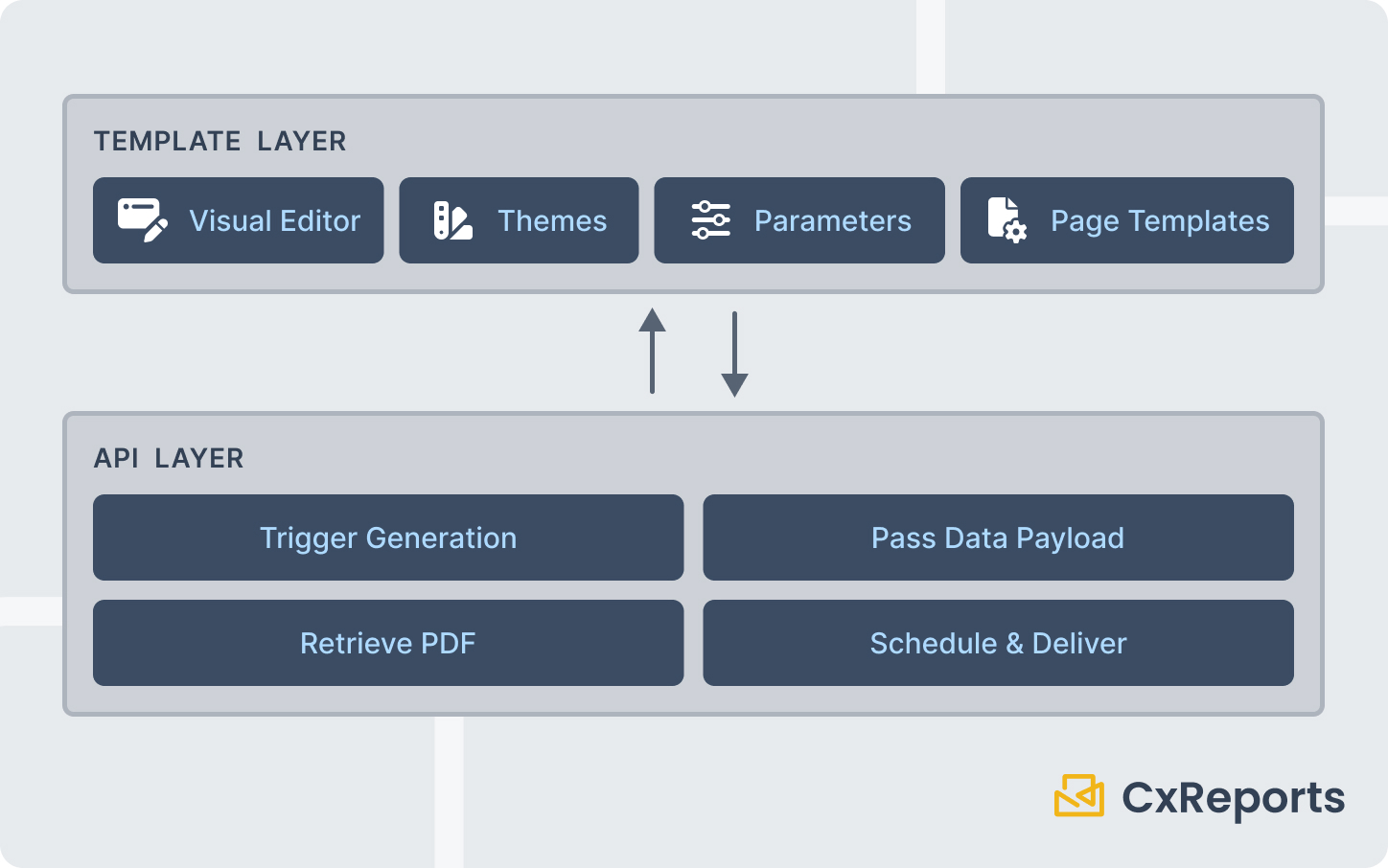 This is the architecture that resolves most of the false dichotomy: business users design and maintain report layouts through the visual layer; engineering teams integrate generation into application workflows through the API. Neither team is constrained by the other.
How CxReports implements this
CxReports is built around the hybrid model - a visual template editor that exposes full API access.
The template layer. Reports are designed in a drag-and-drop visual editor - tables, charts, text components, flow containers, conditional sections. Themes control typography, colors, and table styling globally, so a rebrand is a theme edit. Page templates define header and footer layouts per page type. Report authors - not developers - maintain layouts.
Data connectivity. Data sources are configured per report: SQL databases, REST APIs, JSON payloads, CSV files. Parameters control what data is fetched and which sections are visible. A customer_id parameter scopes the data to a specific account; a document_type parameter activates the credit note section or suppresses the payment instructions page.
The API layer. Every report is triggerable via REST API - pass the parameters, optionally override the data payload, receive the PDF. The same reports accessible in the visual editor are the ones the API generates. There's no separate code path for programmatic generation.
Scheduled delivery. Jobs handle recurring generation and distribution - scheduled by time or triggered by events, with email delivery or Google Drive upload. Volume scaling is configuration: adjust concurrency and schedule windows.
Deployment. Cloud deployment is a CxReports-managed service across EU, US, and AU data centres. On-premise deployment runs on Docker or a Windows service for organisations with data residency requirements.
Getting started with CxReports
| Scaling requirement | CxReports capability |
|---|---|
| Template-based layout design (no code) | Visual drag-and-drop editor |
| Multi-tenant branding | Themes per workspace or per report |
| Conditional sections and page visibility | Parameters + Page Visibility Expressions |
| Programmatic PDF generation | REST API with data payload |
| Data from SQL, APIs, or JSON | Data sources configured per report |
| Scheduled and batch generation | Jobs with scheduling and email/Drive delivery |
| On-premise deployment | Docker or Windows service |
| Cloud deployment | CxReports-managed service (EU / US / AU) |
Documentation: docs.cx-reports.com
API reference: docs.cx-reports.com/administration/integration/api
Report parameters: docs.cx-reports.com/reports/parameters
Deployment options: docs.cx-reports.com/getting-started/install
To see how the template and API layers work together for your reporting requirements, request a demo.F