

Every few years a new wave of technology promises to transform how organisations produce and use reports. Today that conversation includes AI generation, real-time streaming, no-code tools, and cloud infrastructure.
These technologies are real and some are already useful in practice. However, not every trend applies equally to every organisation. In many cases the discussion around them skips an important detail: the trade-offs.
Several of these developments introduce tensions that rarely appear in vendor messaging. This article looks at what is genuinely changing in business reporting, what is not going away, and how to evaluate reporting platforms when innovation meets the practical requirements of regulated, high-stakes environments.
What's genuinely changing
Automation is becoming the baseline expectation
A few years ago, automating report generation and delivery was an advantage. Today it is the expectation. Finance teams that still manually assemble monthly packs are an exception, not the norm. Operations teams expect scheduled reports in their inbox at 7 AM, not at 10 AM when someone eventually prepares them.
This is not just about convenience. As report volumes grow, with more customers, more entities, and more regulatory obligations, manual processes do not scale linearly. A team that can produce 50 reports manually cannot produce 5,000 the same way. For the batch architecture that makes 5,000 reports manageable, see Batch Document Generation. Automation makes growth manageable without proportional increases in headcount.
Embedded reporting is becoming standard
Reports that live in a separate tool users must navigate to are increasingly second-class. The expectation is that reports appear inside the application the user is already using. This may be a customer portal, an internal platform, or a finance system.
This shift puts pressure on reporting infrastructure. Platforms now need to support iframe embedding, API access, and programmatic generation rather than relying only on “export to PDF and email.”
Low-code and no-code tooling is reducing developer dependency
The design and maintenance of report templates once required a developer. Modern visual editors have moved much of this work to business and operations staff. A finance analyst can adjust a chart or add a column to a table without opening a ticket.
This matters because report templates change frequently. Data requirements evolve, regulations update, and branding changes. Keeping a developer involved in every change slows the process significantly.
Cloud-first architectures are dominant, but not universal
For most organisations a managed cloud reporting service reduces the infrastructure burden. There are no servers to maintain, no upgrades to schedule, and scaling happens automatically.
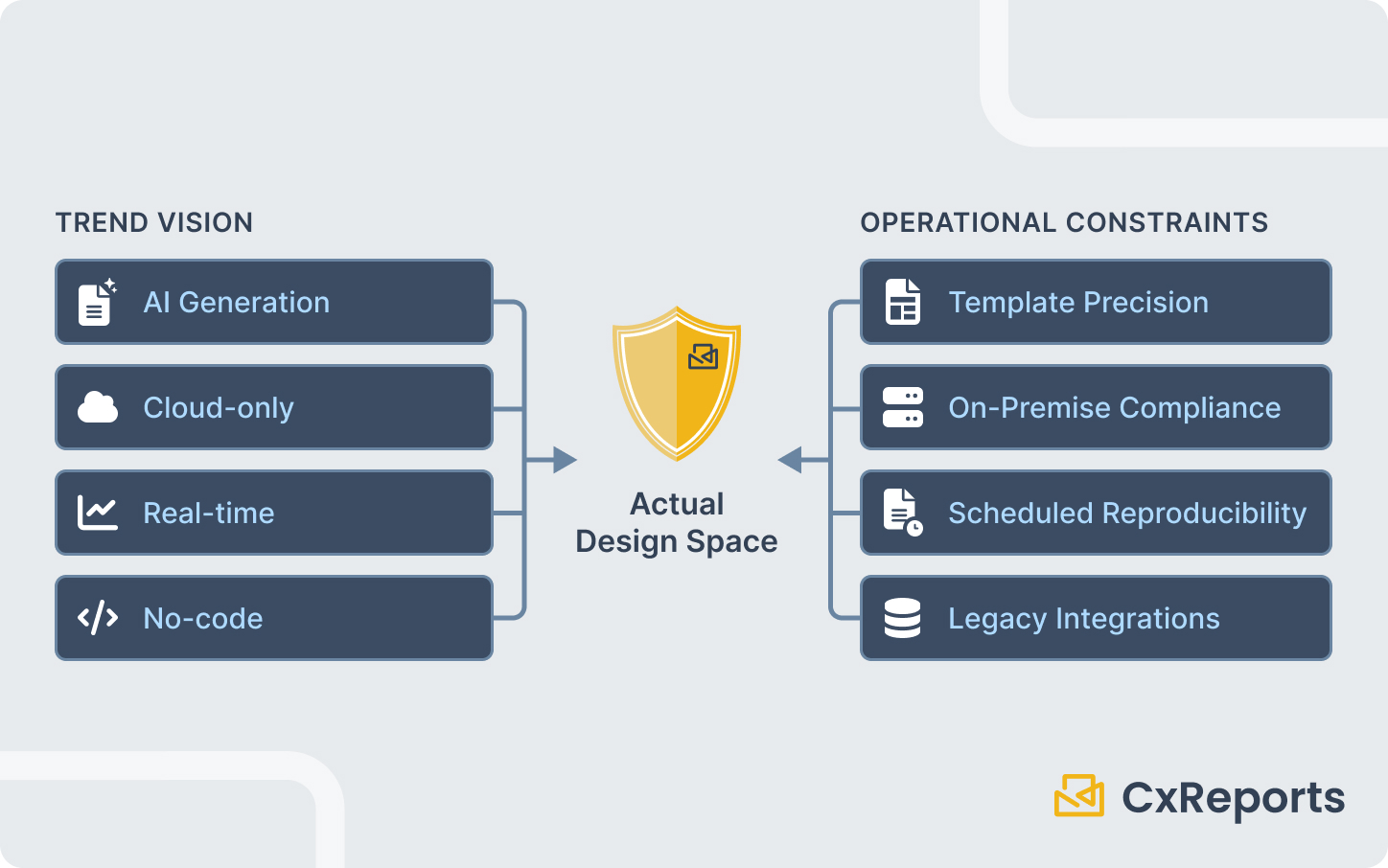
The trend toward cloud-first architecture is clear. However, cloud-first does not mean cloud-only.
API-first design is enabling composability
Reporting platforms that expose well documented APIs can integrate into existing workflows, orchestrated by other systems and embedded in products.
This composability allows external systems to trigger report generation, push data to reports, retrieve PDFs, and automate distribution through existing infrastructure.
The reality check: what these trends don't solve
The trends above are real. What is discussed less often is where they run into hard limits, particularly in regulated, compliance-sensitive, or high-stakes reporting environments.
AI generates insights. It does not replace precision.
AI-powered tools are genuinely useful for pattern recognition, anomaly detection, and natural-language summaries. They are not a replacement for controlled template-based generation of regulatory filings or client statements.
A quarterly client statement must be exactly right. Every number must be traceable to a source. Every layout element must remain consistent. The output must be reproducible on demand during an audit.
AI-generated content introduces variation by design. It produces outputs that are plausible and generally correct, but not outputs that are guaranteed to match a defined template.
For exploratory analysis and internal summaries this is acceptable. For compliance documents it is not.
The honest picture is that AI will augment reporting workflows by flagging anomalies, translating labels, and generating internal commentary. It will not replace template-based generation for documents that must be pixel-perfect and legally reproducible.
Pixel-perfect PDF output is not going away
PDF has been declared dead many times. It continues to persist for good reason.
Regulatory filings require specific layout and pagination. Legal letters follow prescribed formats. Client statements contain mandatory disclosures and branding requirements. Annual reports often go to print.
For these scenarios, "close enough" is not acceptable. The layout must be exactly right every time.
Dashboards and embedded analytics serve a different purpose. They support exploration and monitoring. They do not replace a signed, formatted document that can be presented to a regulator, a court, or an audit committee.
On-premise deployment isn't going away for regulated industries
Banks, healthcare organisations, and government entities in many jurisdictions cannot send certain data to cloud providers. Data residency requirements, internal security policies, and regulatory constraints make cloud-only platforms unsuitable.
The move toward cloud-first infrastructure is real. The assumption that everyone will follow that path is not.
A reporting platform that only runs as a managed cloud service has a market. A platform that can run on-premise, in a private cloud, or in hybrid environments with identical capabilities has a broader and often more valuable proposition for regulated sectors.
Template-based reporting provides consistency that AI-driven generation cannot replicate
When 50,000 customers receive monthly statements those documents must be consistent. The font, layout, table structure, and pagination must match across every instance, varying only in the data.
Templates ensure this consistency. AI-driven generation, by contrast, is fundamentally non-deterministic. It produces varied output based on input prompts, which may be useful for some tasks but unacceptable for mass-produced compliance documents.
Template-based reporting also allows organisations to answer an important question.
"What exactly did this document look like when we sent it?"
With version-controlled templates and reproducible output the answer becomes clear. That forms the basis of a defensible audit trail.
Legacy system integration remains a real constraint
Cloud-native tools often assume modern APIs and clean data pipelines. Many organisations operate in very different environments.
Data frequently lives in SQL Server databases, legacy ERP systems, or internally developed applications that existed long before REST APIs became common. A reporting platform that cannot connect to existing systems offers little practical benefit.
Practical recommendations
Given the tension between these trends and the counter-pressures, several principles hold across industries.
Embrace automation without sacrificing control.
Automating report generation and delivery is the right move. The risk appears when automation removes visibility. Good automation produces a clear record of every run, including what was generated, with which parameters, delivered to whom, and at what time.
Keep humans in the loop for critical reports.
An optional review step is often underused. Generating reports automatically but requiring a sign-off before delivery adds an important safety check for board packs, regulatory filings, and client statements.
Balance innovation with regulatory requirements.
New capabilities such as AI summaries, embedded analytics, and real-time feeds should complement compliance infrastructure rather than replace it.
Invest in API-first, template-based solutions.
API access enables composability. Template discipline guarantees consistency and reproducibility.
Plan for hybrid deployment.
Even if your current infrastructure is fully cloud-based, regulated partners or clients may require on-premise deployment.
Where CxReports fits in this landscape
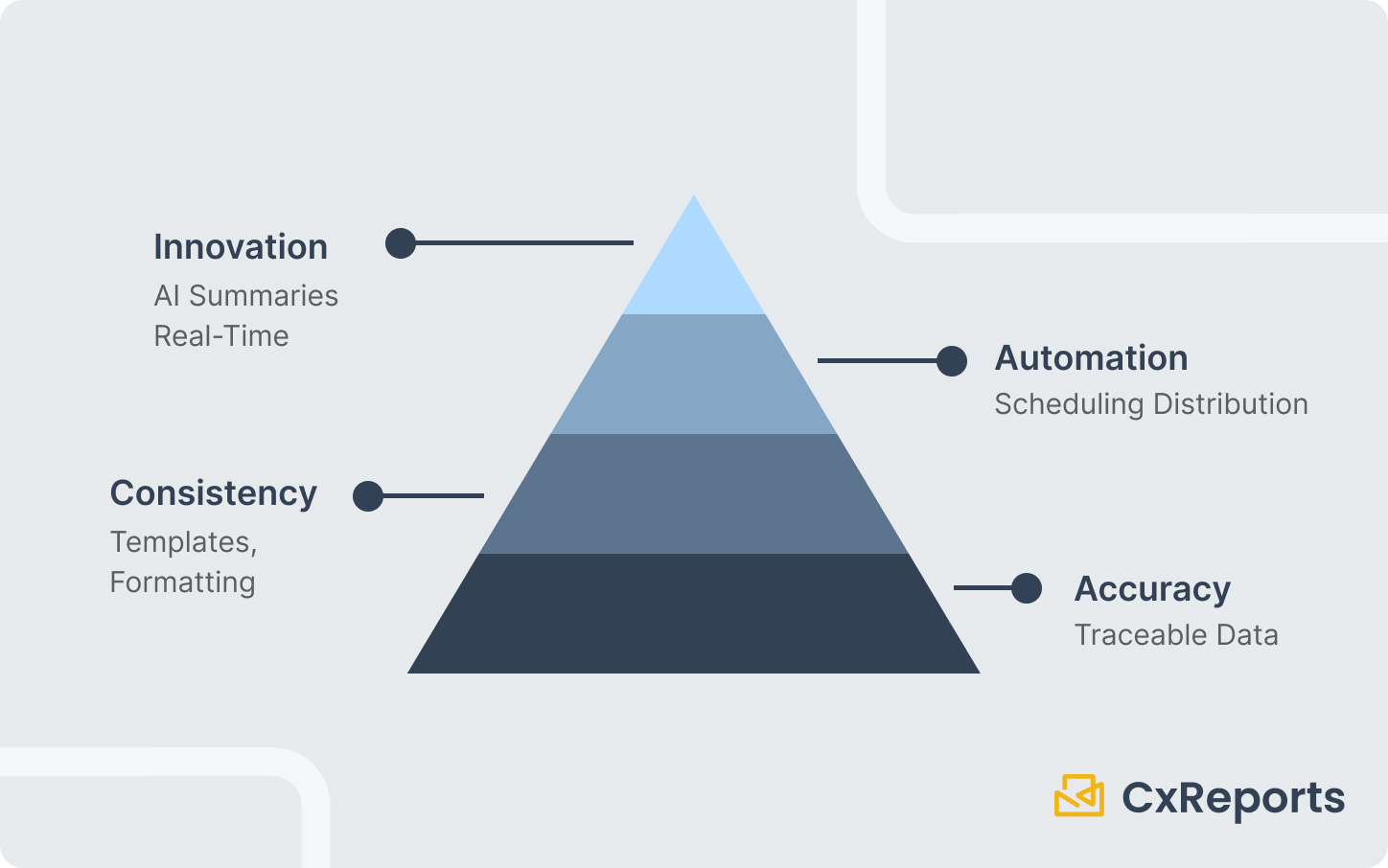
CxReports is designed around properties that remain important despite shifting trends: template-based consistency, pixel-perfect PDF output, API-first architecture, and flexible deployment.
Template-based generation with a visual editor.
Templates are designed in a WYSIWYG editor. Layout and formatting changes do not require code. Business and operations staff can update charts, columns, and layouts while maintaining template discipline.
Pixel-perfect PDF output.
CxReports supports multi-page documents with automatic pagination, headers, footers, tables of contents, and complex data layouts.
Automation via Jobs and scheduling.
Reports can be generated and delivered automatically on scheduled intervals. Jobs handle report generation, parameter mapping, email delivery with dynamic recipient lists, and uploads to cloud storage. Each run creates a timestamped execution log.
API-first architecture.
A REST API and official clients for Node.js, C#, and Python enable programmatic report generation, data push workflows, and embedded reporting integrations.
Cloud and on-premise deployment.
CxReports can run as a managed cloud service in EU, US, or AU regions, or as a self-hosted installation. Both options provide the same feature set.
AI-assisted design and translation.
CxReports connects to AI models through workspace AI integrations that use your own provider API key (OpenAI, Anthropic, Google, or DeepSeek). The same integrations serve two uses. The first is an AI assistant in the Report Editor that builds and modifies report elements, pages, and data sources from plain-language instructions. The second is translation of dictionary entries for multilingual reporting. In both cases AI speeds up design work. It is not the source of regulated content, which still comes from your data and your reviewed templates.
A practical way to think about platform choices
When evaluating reporting platforms several questions help distinguish durable solutions from trend-driven ones.
Can it generate exactly the same document twice?
Template-based, version-controlled generation provides reproducibility.
Can it run where your data is?
Cloud-only solutions exclude many regulated environments.
Can it integrate with existing infrastructure?
API access and database connectivity determine whether a platform fits real systems.
Does automation create an audit record?
Execution logs, timestamps, and delivery history are essential for regulated reporting.
Who can modify report templates?
If every change requires a developer, the system creates operational bottlenecks.
CxReports is designed to answer yes to each of these questions. Organisations balancing modernisation with strict reporting requirements often find that these criteria matter more than whichever platform announces the newest feature.
Explore the documentation at docs.cx-reports.com or get in touch to discuss your reporting requirements.